Celebrities are usually known for their biggest successful works, but most of them stepped into the entertainment world with smaller roles. A lot of them have been in the industry for so long that we’ve forgotten what they looked like when they first started. Taking a look at some of their earliest works is indeed a blast from the past.
Bright Side looks into some of the earliest works from certain actors and is amazed at how much they have grown within the industry.
During a special screening of Gemini Man for influencers, Will gets into the details of how director Ang Lee and WETA managed to create a fully digital version of a 23-year-old Will.
Director Shane Black aims to revive the stagnated Predator franchise with an all-new film in which the terrifying hunter turns his terror to a suburban landscape. Check out the brand-new trailer for The Predator above before the film lands in theaters on September 14th.
From the outer reaches of space to the small-town streets of suburbia, the hunt comes home in Shane Black’s explosive reinvention of the Predator series. Now, the universe’s most lethal hunters are stronger, smarter and deadlier than ever before, having genetically upgraded themselves with DNA from other species. When a young boy accidentally triggers their return to Earth, only a ragtag crew of ex-soldiers and a disgruntled science teacher can prevent the end of the human race.
The series kicked off in 1985 with the Arnold Schwarzenegger-starring Predator which saw mercenaries heading to Guatemala, only to be confronted by the terrifying extraterrestrial as it hunted them down and brutally killed them one by one. The film spawned two sequels and two films in which the Predator faced off against xenomorphs from the Alien franchise, though none of these follow-up films matched the success of the original endeavor.
For this new film, Black found himself trying to reinvigorate the franchise by bringing it in new directions while also honoring the series' classic formula.
“Well, I think that there’s a basic premise that has to be honored every time you make a Predator film and that’s in some way, whatever the plot turns out to be, it has to, at some level, represent a hunt. But, beyond that, I think there’s infinite variability," Black shared with Collider. "It’s like monkey bars. You ever play on the jungle gym when you were a kid? It looks like they’re rigid and hard and it’d be hard to play on these things because they’re so rough, but if you go inside them there’s actually a lot of room to move around, you just know that the borders are there every once in a while.”
The Predator stars Boyd Holbrook, Trevante Rhodes, Jacob Tremblay, Keegan-Michael Key, Olivia Munn, Sterling K. Brown, Alfie Allen, Thomas Jane, Augusto Aguilera, Yvonne Strahovski, and Jake Busey.
The premiere of Avengers: Infinity War is just under three weeks away and marketing for the movie — said to be Marvel's largest campaign to date — is well underway.
With that, a fresh new television spot has been released that treats us to all sorts of new footage from the upcoming entry into the Marvel Cinematic Universe.
Beginning with Peter showing of his Spidey sense, we get a quick new shot at the large Outrider ship that crashes into Wakanda.
The next new shot is sure to please fans all across the Marvel Cinematic Universe as Steve and Bucky meet up, apparently the first time since the two parted in the post-credits scene in Captain America: Civil War.
The role of Wolverine has to be recast now that Hugh Jackman is done, and a lot of fans have been calling for one actor in particular to step into the role: Scott Eastwood. If you've been wondering or debating what the Fate of the Furious and Suicide Squad actor would look like as the X-Men's razor-clawed berserker, then look no further than this new artwork from our friend BossLogic:
While Scott Eastwood recently stated interest in playing Wolverine, the comments thread in this Twitter post prove one thing: fans are definitely split on the idea. The responses range from approval of the likeness, to David Beckham comparisons, criticism of Eastwood's acting, to those who think this idea is downright sacrilege. The suggestion of Eastwood also brings out the usual competing actor suggestions; a quick scan of comments shows that names like Luke Evans (Fast and the Furious 6) and Taron Edgerton (Kingsman) are still leading the pack of fan-cast Wolverines.
As for Eastwood: according to a lot of fan response, there's some leeway with what version of Wolverine Eastwood could conceivably play. The image above looks like it could be an adaptation of the Ultimate Universe version of Logan, but it could just as easily be James Hudson Jr., Logan's son from that same Ultimate Universe. Some fans go so far as to suggest that it could be Logan's son from the main Marvel Universe, Daken, but considering the character is half Japanese, it's probably best we don't go there.
Right now, the X-Men movie franchise is in a state of serious flu(x). Deadpool 2 is going back for reshoots after some less-than-stellar test screenings; New Mutants was delayed nearly a year to 2019; and X-Men: Dark Phoenix is still largely a dark horse x-factor in this equation, since we seen no trailers yet. All in all, the power position that the X-Men franchise seemed to hold in the 2018 movie race has all but dissipated. And now that the franchise has been sold to Disney, and will eventually be incorporated into the Marvel Cinematic Universe, the question of what's going to happen with the (re-)casting of these characters is definitely an important one for Phase 4 of the Marvel Cinematic Universe.
The X-Men Movie Universe continues with Deadpool 2 on May 18th; X-Men: Dark Phoenix on November 2nd; and The New Mutants on February 22nd, 2019.
We're currently going though a period in movie history that will be remembered as the time when CGI started to seamlessly blend with live action. Hollywood blockbusters have become increasingly reliant on visual effects over the past few decades, but recent advances in technology have made it so feats in VFX work that were considered impossible just a few years ago are well within reach.
As the scope of what can be achieved with computer-generated imagery widens, the more studios are tempted to use it—not just out of necessity, but simply because it's often cheaper than the alternative. In fact, many modern blockbusters are covered in so many digital layers that the original footage looks unrecognizable—and more often than not, completely ridiculous. Here's what these movies really looked like before special effects were added
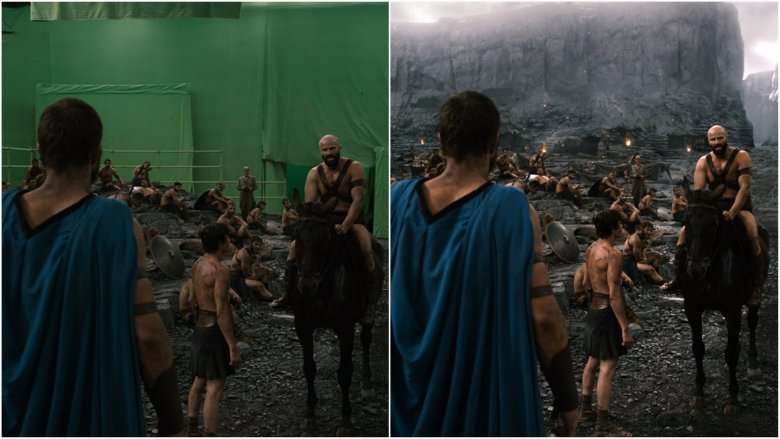
300: Rise of an Empire (2014)
Set before, during and after the events of the first movie, 300: Rise of an Empire lacked Zack Snyder's "shrewd deconstruction" of Frank Miller's graphic novel as well as the "staunch physical presence" of Gerard Butler in the lead role. Butler famously got super-jacked for 300 using an insane workout, though CGI was still needed to bring the world around him to life, and the technology used to create it had advanced immensely by the time Rise of an Empire came about.
"It's amazing how the tools available eight years later continue to develop," director Noam Murro told Forbes. "A major difference is CGI and the ability to create things in post that are convincing and complex and three-dimensional. The idea of creating a water movie without a drop of water on the set is remarkable." The filmmaker also revealed they relied on some of the same techniques used in the Oscar-winning CGI blockbuster Gravity.
Elysium (2013)
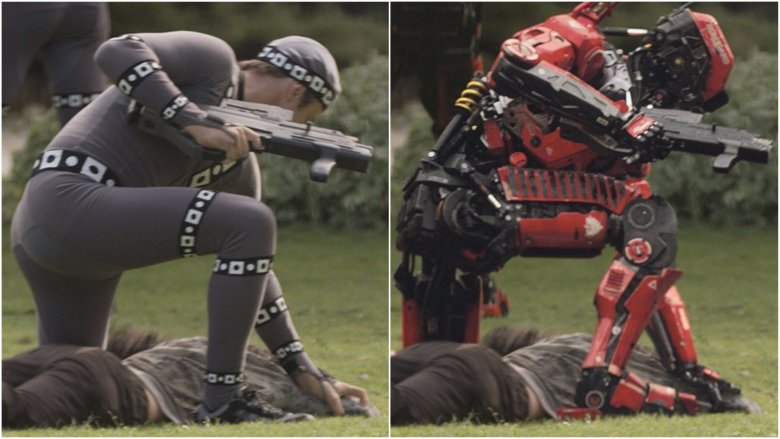
Neill Blomkamp's follow-up to his acclaimed debut District 9 didn't exactly go as planned, despite the star power of Matt Damon. The blockbuster sci-fi cost a whopping $110 million to make, but only returned $93 million at the domestic box office. Blomkamp took full responsibility for the film's failings, telling Uproxx that he "f***ed up" the script. "I feel like, ultimately, the story is not the right story," he said. "I almost want to go back and do it correctly… I just didn't make a good enough film is ultimately what it is."
The South African director didn't have any complaints about the special effects team, however, who were expertly led by his trusted collaborator Peter Muyzers. "Having worked with Neill before, we were able to prepare well in advance for Elysium and really get things into place," Muyzers told Collider. "So the real challenges on that film were just the variety of character work … There were about three times as many shots in Elysium as there were in District 9 from a visual effects point of view
Jurassic World (2015)
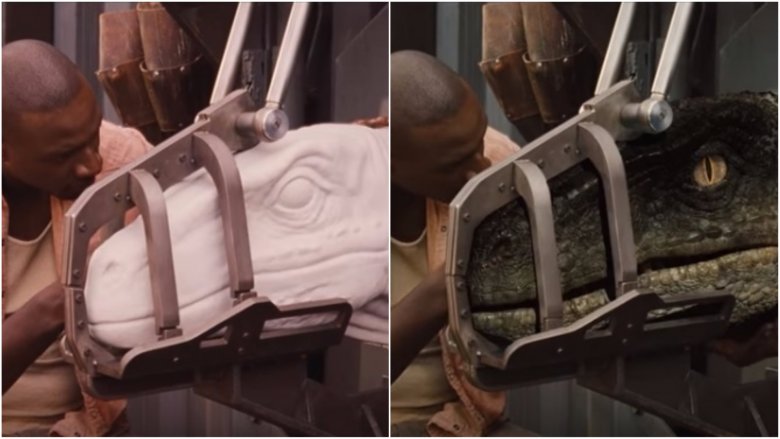
When Steven Spielberg decided to adapt Michael Crichton's novel Jurassic Park, CGI as we know it today didn't really exist. Universal assembled the top visual effects talent in the business for the project, but despite Spielberg's kids being impressed with early tests done using stop-motion technology, the veteran director wasn't quite satisfied. Industrial Light and Magic (who at this point had done little more than render liquid metal in Terminator 2) were tasked with creating living, breathing dinosaurs using computer-generated graphics, and their efforts proved revolutionary.
Of course, it wasn't just CGI that brought the inhabitants of Jurassic Park to life. There were a number of practical effects used too, and ILM mixed it up in the same way for Jurassic World. The fourth film in the franchise used detailed white casts of dinosaur heads that would later be layered with CGI for close-up shots, and they used actors in motion capture suits to make sure their movement seemed real. "It gave us a new natural look for the animation," VFX supervisor Tim Alexander told Below the Line. "We ended up casting a person to give us a consistency in the performance. There were individual people being that raptor. We had suits that they would put on with a tail."
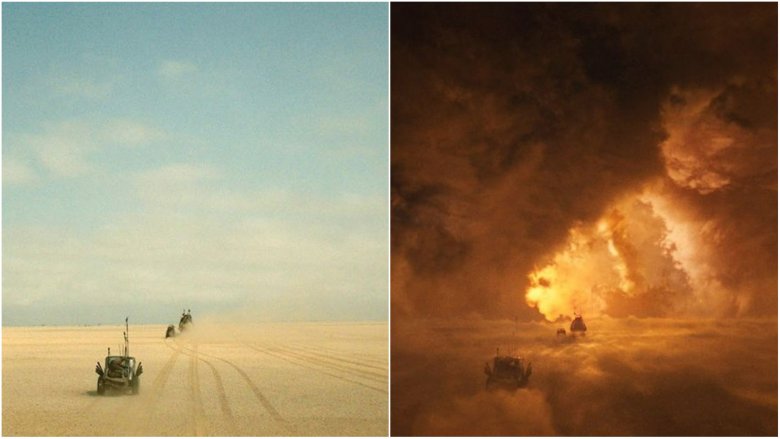
Mad Max: Fury Road (2015)
When George Miller returned to the world of Mad Max with his critically acclaimed tour de force Fury Road in 2015, audiences were blown away by the sequel's frenetic pace and visceral action—much of which was achieved through the hard work of inventive mechanics who built the weird and wonderful vehicles used in the movie from scratch. "Mad Max was always about cars," production designer Colin Gibson said. "The cars were a metaphor for power, and the one thing that George was very keen on and understood, I think, was that in a world where there's next to nothing, what little there is left needs to be loved."
The chase scenes were all shot for real, but the final product wouldn't have looked anywhere near as eye-popping if it weren't for the VFX team. Led by supervisor Andrew Jackson, hundreds of CGI artists enhanced over 2000 shots in Fury Road, from adding characters to creating an epic toxic storm. "We sourced a huge amount of real twister footage to find visceral effects we liked and thought would work well for this sequence," CGI artist Tom Wood told IndieWire about creating the movie's biggest VFX scene. "Lightning strikes were added as light sources, casting shadows onto and lighting through the dust layers."
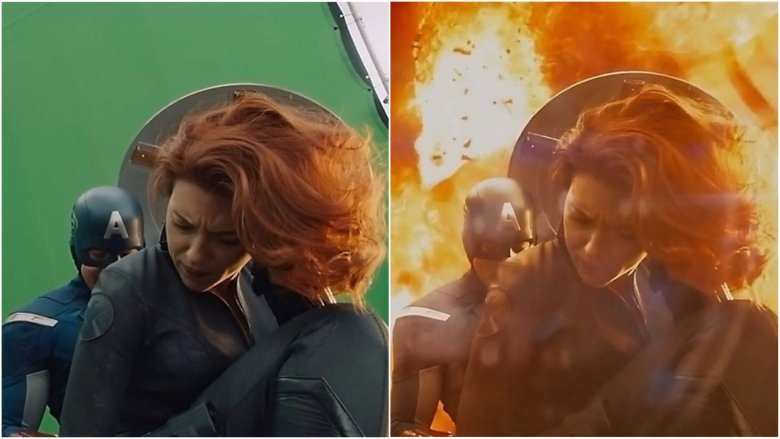
The Avengers (2012)
When Earth's Mightiest Heroes teamed up on the big screen in 2012, the stakes were high for Marvel Studios and their team of visual effects artists. "With Avengers, there were so many things to get right," Jeff White, the film's VFX supervisor, told MTV. "We created a lot of New York City for the film and needed to build flying shots of Iron Man all from photography. We had to build a new Iron Man suit—the Mark VII—and Stark Tower. We had to build the alien race. When you add all of those things up, there are quite a few challenges there."
Green screens were used during most of the film's action sequences, so the cast spent a good chunk of time reacting to invisible threats and taking cover from fake explosions. The biggest hurdle they faced was inserting the Hulk (Mark Ruffalo) into group situations. "We wanted it to feel very natural when he's sitting in that circle of Avengers," White said. "We spent a lot of time working on his skin and his hair and his teeth, just to make sure that all of that was believable."
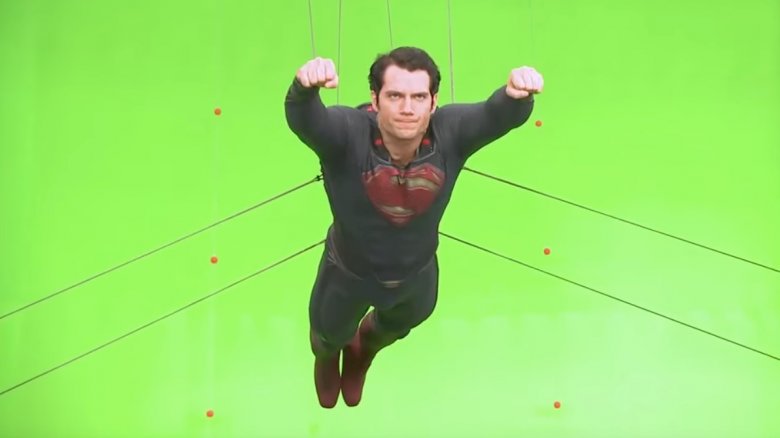
Man of Steel (2013)
To create the illusion of flight, Richard Donner's Superman (1978) employed wire rigs to hang leading man Christopher Reeve in front of different projected backgrounds. The film is a classic, and the effects looked great in the '70s, but watching it today it feels as though you're flying with Superman as opposed to him flying past you—something Man of Steel director Zack Snyder wanted to avoid when he enlisted the help of John "DJ" DesJardin, known for his work on the Matrix sequels as well as Watchmen (2009) and Sucker Punch (2011).
"I think a lot of the direction for the flying came from Zack's style for the movie," DesJardin told The Verge. "He said to us, 'I want this to be really cinéma vérité, documentary-style. I think it needs to be handheld. It's going to be 24 frames, no slow motion. It's going to be anamorphic, so if you look up at the sun there's going to be a big flare going across the screen.' And once we got into that mindset, a lot of camera-style questions got answered really quickly about how the flying should be done." Wire rigs and gimbals were used to suspend Henry Cavill in front of green screens, and DesJardin's team did the rest.
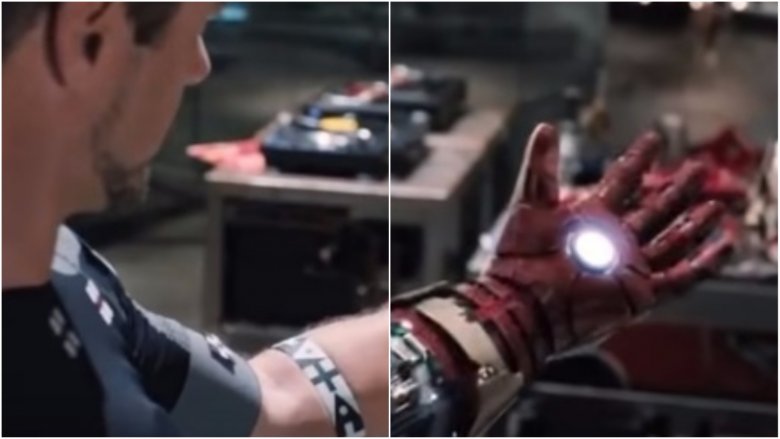
Iron Man 3 (2013)
When the first Iron Man movie dropped in 2008, director Jon Favreau wasn't known for CGI-heavy features, but advances in technology had convinced him to change his stance. "I've always skewed away from using visual effects whenever possible," he said. "I think that there are certain things you can't achieve otherwise, but in the past I've always been reticent to use visual effects to the extent that other filmmakers might. That being said, in the last few years there's been a lot of wonderful visual effects movies where it's beginning to become seamless even to me."
Favreau returned for the sequel, but Shane Black took the reins for Iron Man 3, which contained some of the most trying visual challenges yet. "We wanted the ability to be able to suit up anywhere, anyhow, without a giant gantry," Marvel Studios head honcho Kevin Feige said. The answer was having Tony Stark design outlets he injects just below the skin, allowing him to call the Iron Man suit from anywhere. The scene in which he tests this new tech goes comically wrong when Stark is thrown all over his workshop by his rogue suit, which had to be digitally added to the actor's body after the fact.
The Planet of the Apes (2011-2017)
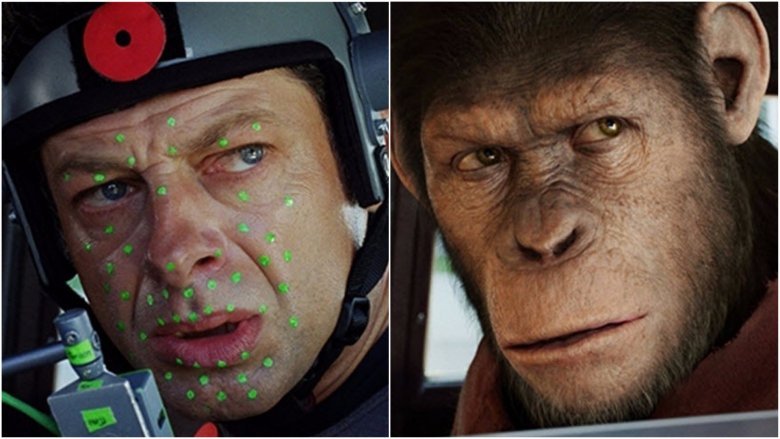
Effects studio Weta Digital changed the game when they helped reboot Planet of the Apes with a new trilogy of prequels, beginning with 2011's Rise of the Planet of the Apes. "Weta brought their technology to another level for this movie to make our apes look real," said producer Dylan Clark, who had an equal amount of praise for Andy Serkis. The industry's top performance capture artist shone as protagonist Caesar, redefining screen acting in the digital age. "His facial expressions and body language are so evocatively and precisely rendered that it is impossible to say where his art ends and the exquisite artifice of Weta Digital begins," The New York Times enthused in their review of 2014's Dawn of the Planet of the Apes.
Fox campaigned for Serkis to get an Oscar nomination, but the call from the Academy never came, much to the actor's frustration. "The awarding bodies should not discriminate about this being different," he told Independent after the release of 2017's War of the Planet of the Apes. "The visual effects render the character, just like putting on makeup, except here it happens after the fact. It's digital makeup, if you will."
Spider-Man: Homecoming (2017)
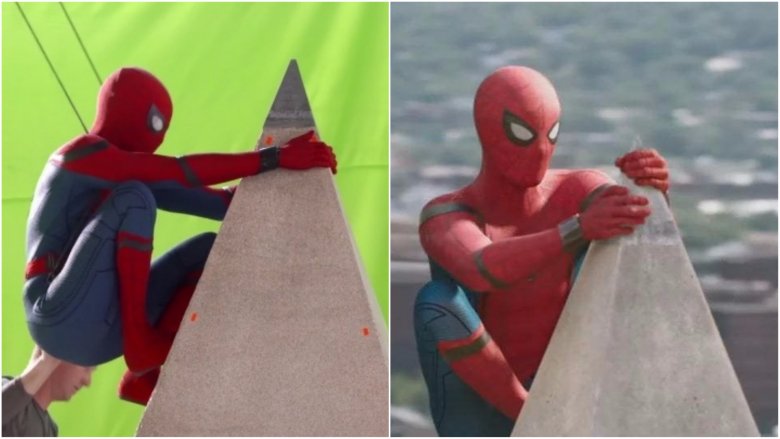
Years of gymnastics training really paid off for Tom Holland on the set of Spider-Man: Homecoming, the character's eagerly anticipated introduction to the Marvel Cinematic Universe. Even with the advances in CGI in recent years, it helps to have an actor who feels comfortable jumping around in tights and doesn't mind hanging around on wires all day long. This was the case with the film's Washington Monument scene—but while that was indeed Holland under the Spidey mask, the monument itself was a fake, erected on a studio sound stage.
"We couldn't film at the real Washington Monument, but we built very impressive, very large chunks of the monument for filming," stunt coordinator George Cottle told MTV. Holland got up the structure with the aid of a wire rig, though even with his background it was far from a walk in the park. "We did two weeks and every single shot was upside down," he said. "My head just took a pounding from all the blood that was rushing to it."
The Jungle Book (2016)
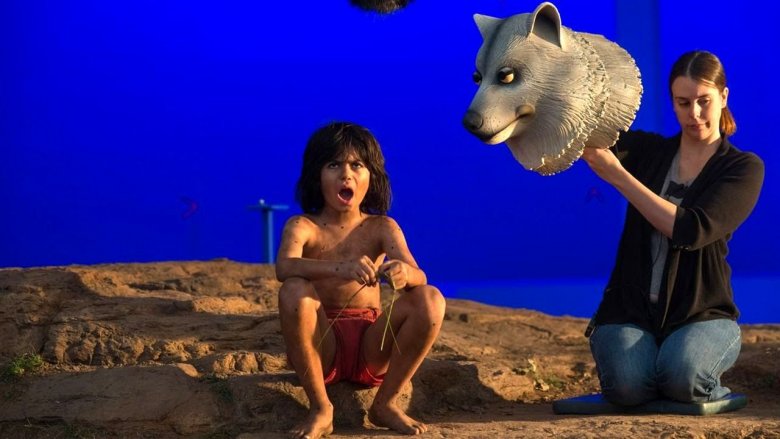
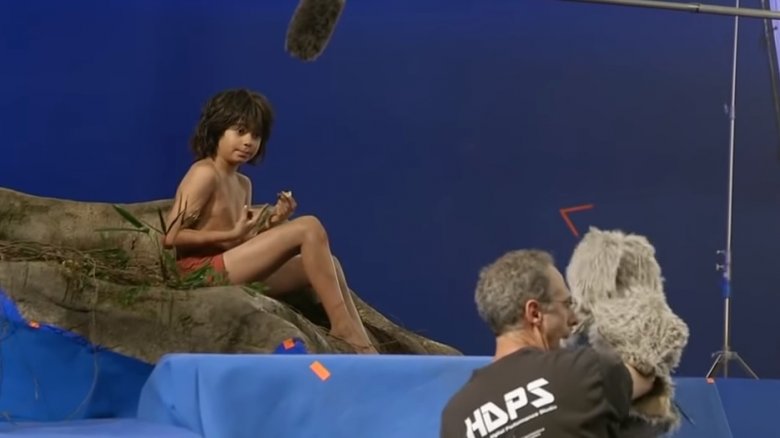
While Jon Favreau embraced CGI for Iron Man, the experience he had making that film was nothing compared to what he did for his 2016 live-action adaptation of The Jungle Book. Technology had advanced to the point that photo-realistic digital animals were possible, though to create an entire jungle around a human actor, they needed to pull out all the stops. "It's very hard to fake light and shadow," the director said. "So everything became about using panels of LEDs to project light so if we had the kid bowing before the elephants, you have panels where we actually would pre-animate the elephants and they would cast the shadows on the kid in the exact right way."
This meant that 12-year-old star Neel Sethi had to imagine the animals he was interacting with, though Favreau was on hand to make the experience as real as possible for the young actor. "There were puppets that helped me, so it wasn't just a tennis ball that I was trying to have emotion with," Sethi told Independent. "Jon got into the puppet at times, I got to interact with him, which made it a lot easier."
RoboCop (2014)
Paul Verhoeven's RoboCop got the most out of the special effects available in '80s, using a combination of stop-motion and prosthetic builds to create a movie that was disturbingly realistic at times. A moving, wincing, incredibly lifelike puppet of protagonist Alex Murphy was made by Oscar-winning special effects artist Rob Bottin for the cop's assassination scene, which was so violent that censors forced Verhoeven to edit the part where the back of Murphy's (Peter Weller) head is blown off.
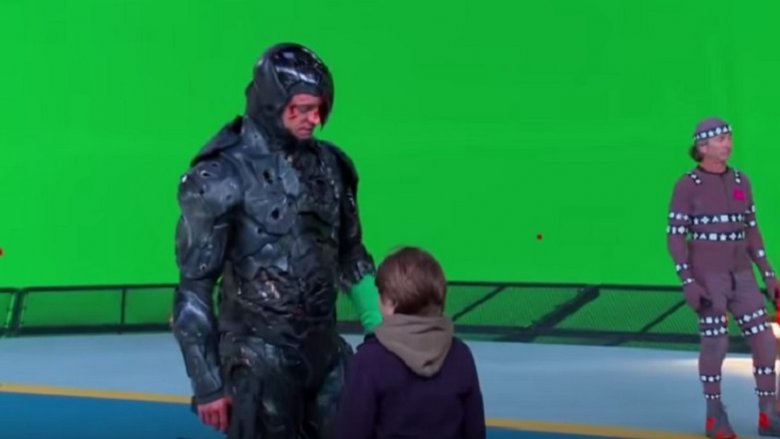
In José Padilha's 2014 reboot, Murphy (Joel Kinnaman) gets his injuries in an explosion that was created digitally, but the suit he dons afterward was actually real. "As the first RoboCop film showed us, a real actor in a real suit makes for a very, very bulky suit," FXGuide's Mike Seymour told Wired, and this was something the special effects team had to counter in their new design. "There was a philosophy from the start that we were going to have a head to toe suit," co-owner of Legacy Effects John Rosengrant said, explaining that his team went to great lengths to design a suit that was mobile and easy for the digital department to add to.
The Martian (2015)
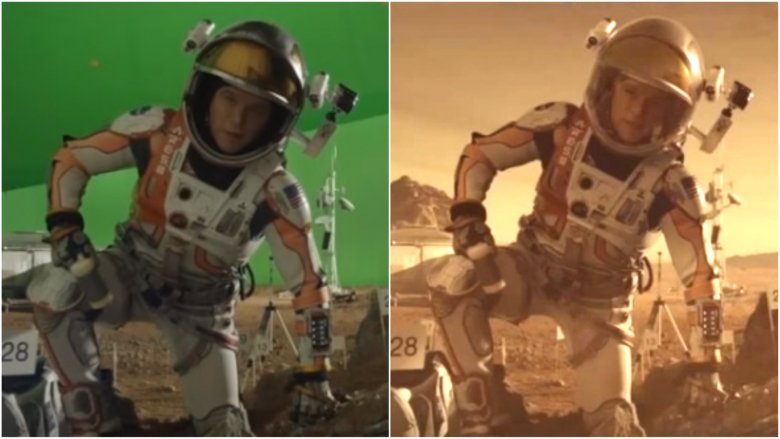
Ridley Scott is no stranger to special effects, but creating the red planet onscreen for The Martian may have been his biggest challenge as a director. While some practical effects were used—the dust storm that Matt Damon gets lost in, for example, was created using fans—a huge amount of digital work was required to give The Martian Scott's desired look. "He's famous for doing his little sketches which are sort of really cool Ridley-grams," VFX supervisor Anders Langlands told Gizmodo. "We'd ask 'What do you want the background mountains to look like in this shot?' And he'd sketch out a little diagram of what they wanted. So you just literally match that and he'd be happy."
A lot of hours were spent finding the right hue for the skies and arid landscapes of Mars, though in the end it was a simple thing that caused the VFX team the most problems. "I think the trickiest thing we came across was actually the reflections in people's visors," Langlands revealed. "Sometimes we'd just take the visor out completely and replace it with a CG one. And then we'd use the environment to generate new reflections that matched what would actually be there."
Suicide Squad (2016)
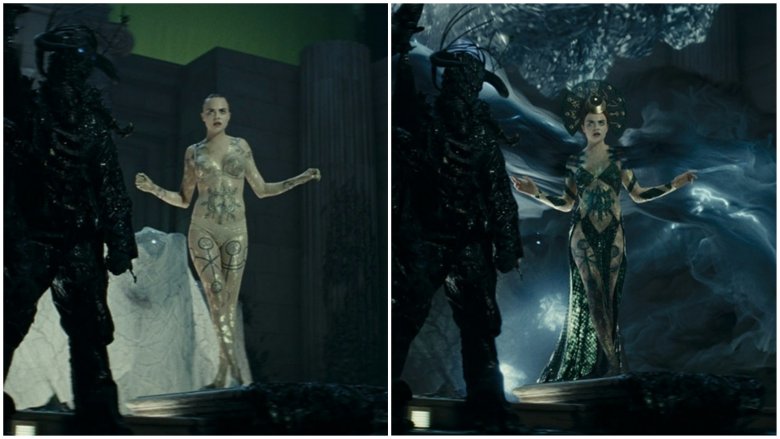
David Ayer's anti-hero ensemble Suicide Squad is a fun but flawed movie strewn with mistakes, though the majority of those errors were made in the editing booth and weren't the fault of the many visual effects houses—18 companies contributed in total—that worked tirelessly on it. Imageworks were the ones who handled the Squad's final battle with Enchantress (Cara Delevingne), and the movie's villain proved quite the challenge according to VFX supervisor Mark Breakspear.
"Enchantress was a unique challenge as the actress had been shot without a costume as we had to add it in later to allow it to behave in a way that normal cloth or materials couldn't," he told ARTofVFX. Breakspear later told AWN that of the 300 shots they enhanced for the film's third act, dealing with the antagonist's tattoos proved the most difficult. "That was amazingly tricky to make sure it looked like skin, but also had the translucency that we needed to see the sub-surface tattoos."
Harry Potter (2001-2011)
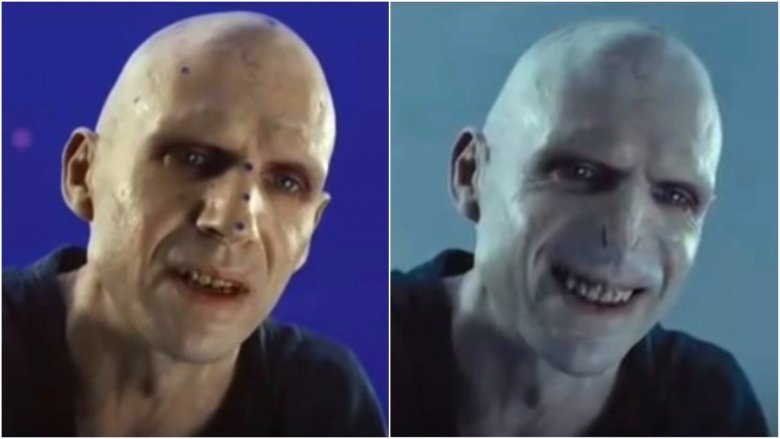
Bringing J.K. Rowling's Wizarding World to life was only ever going to be possible with the help of CGI, and the films made increasingly good use of visual effects with each installment. While early CGI (like the troll in Sorcerer's Stone) hasn't aged well, the quality of digital imagery from Goblet of Fire onward still holds up. The VFX team had to up their game for the fourth film in the series, as it marked the return of Lord Voldemort (Ralph Fiennes). Paul Franklin, the VFX supervisor for Order of the Phoenix and Half-Blood Prince, revealed that creating Voldemort's nose was a mammoth task.
"There's this idea that we put the shots through the computer and it just vanished off [Fiennes'] face," he told RadioTimes. "[His nose] had to be painstakingly edited out, frame by frame, over the whole film. And then the snake slits had to be added and tracked very carefully using dots put on his face for reference." Franklin likened the process to creating a renaissance painting. "The digital brushwork has to be very, very fine to get it to work. The art and time that goes into those nostrils should never be underestimated."
Life of Pi (2012)
Filming this tale of a boy stranded at sea with a Bengal tiger came with a number of obstacles—but the biggest one wasn't the tiger, it was the water. Director Ang Lee had the crew erect the biggest wave pool ever built on a set and shot the entirety of Life of Pi in 3D. "To make an impact with water, you usually need to create a 200-foot wave when shooting in 2D," Lee said at the DVD launch (via Mashable). "I knew that to make it work with 3D, water had to become a character itself. I've never seen realistic water scenes in movies because water hits one side of a tank wall and bounces back like it would in a bathtub, but we needed to make it work."
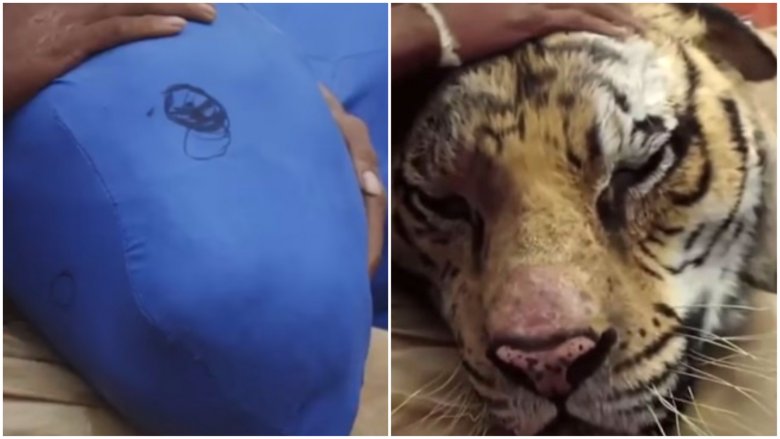
Real tigers were actually used in some shots, but scenes in which Pi (Suraj Sharma) interacts with the deadly animal were done using a crude CGI-friendly puppet. "Life of Pi is definitely one of the most challenging projects I've ever worked on," VFX supervisor Bill Westenhofer said. "We had over 15 artists just working with the fur. Someone has to comb and place all the ten million hairs on its body."
The Hobbit (2012-2014)
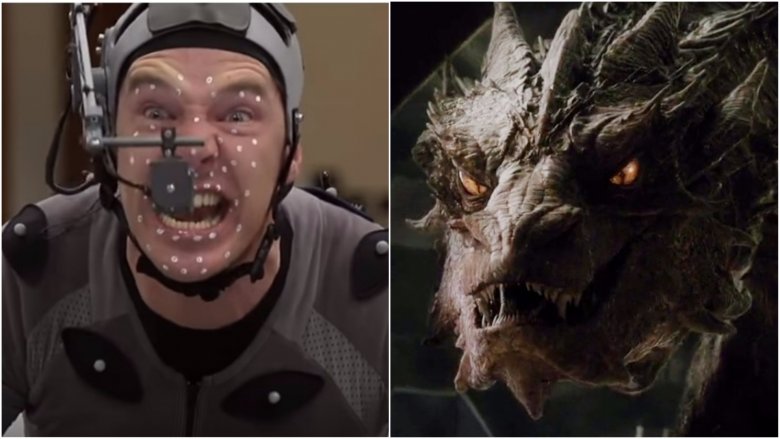
Peter Jackson's The Lord of the Rings trilogy wouldn't have worked if the VFX team didn't nail Gollum, as the CGI character was hugely important to the plot. Weta worked their typical magic on him, but it was the motion-capture performance of Andy Serkis that really brought the devious little creature to life. Serkis reprised the role in Jackson's The Hobbit films, but he wasn't the only actor slipping into a spotted grey suit this time out: Benedict Cumberbatch was brought in to play the trilogy's antagonist Smaug, solely because of his voice.
"It wasn't about what he looked like, it was about what he sounded like and what he was able to produce in the character simply by his voice," Jackson said. "And he knew Smaug, I mean he understood Smaug as well as we did." Cumberbatch revealed that the gravelly tones he gave the psychotic dragon were an imitation of the ones his father used when he read The Hobbit to him as a child. "My dad's an extraordinary actor," the Doctor Strange star said. "He brought this already very rich, magical, visionary world of hobbits and giants and trolls to life."
The Wolf of Wall Street (2013)
The fact that CGI was relied upon heavily for all of the films we've covered so far won't come as much of a surprise, but what's shocking is just how commonplace digital effects have become outside of big-budget blockbusters. Watching Martin Scorsese's ode to excess The Wolf of Wall Street, the only scenes that stick out as being possibly computer-generated are the one during which Jordan Belfort's (Leonardo DiCaprio) yacht sinks and the one when a lion wonders freely through his office, but a visual effects reel released by Brainstorm Digital revealed that some of the most basic shots in the movie were rendered with CGI.
From sun loungers to tennis courts, Brainstorm made plenty of subtle touches to bring the film in line with the director's vision. "A lot of it is not just making things look realistic but making them artistically compelling," VFX producer Mark Russell told Digital Arts. "Working with Martin Scorsese, everything is about propelling a story forward and contributing to the film. I feel that with his movies, there's a kind of stylized realism to them that we have to integrate with."
Game of Thrones (2011-present)
Game of Thrones season finales always have a cinematic quality, thanks in part to the digital wizardry of Pixomondo. A lot of shooting is done on location and green screen use is kept to a minimum where possible, but bringing the creatures of George R. R. Martin's world into the mix requires some top-notch CGI. Pixomondo's VFX supervisor Sven Martin told The Washington Post that one of their biggest achievements has been making Daenerys' dragons blend seamlessly with the world around them, explaining, "This was always our main approach, to not make the dragons too fantastical and too design-driven."
But all that magic doesn't happen until the dragon scenes have been shot, so how does Emilia Clarke connect with her fire-breathing babies? "Well, they have these amazing life-scale models that we used for camera rehearsals for the sake of the CGI people, and I got very attached to them," the actress told Huffington Post. "They genuinely helped me and I kind of got very maternal towards these—fundamentally [they're] dolls, I suppose. But it was nice to have something physical that I could really picture in my mind."
Alice In Wonderland (2010)
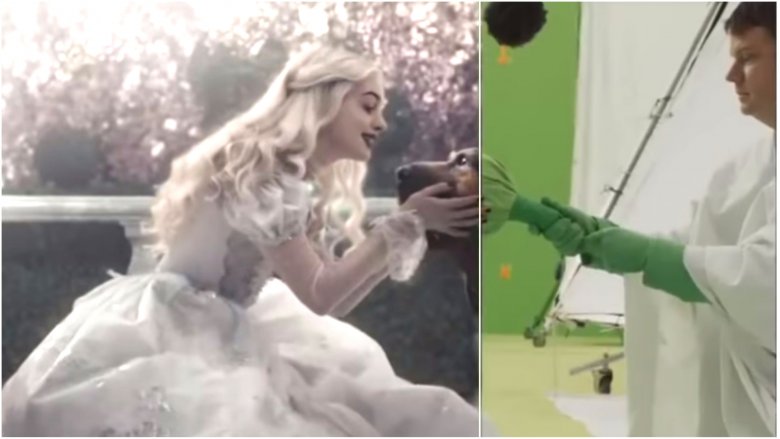
Tim Burton was creating stunning visual effects long before CGI came along, using a combination of practical techniques to bring his dark vision to the screen. The former Disney artist used stop-motion animation, miniatures and puppetry to great effect in his earlier works, though when the opportunity to direct his own version of Alice In Wonderland came along, he soon realized that he couldn't do it without leaning heavily on digital wizardry.
"[I] felt like this was the way to go," Burton told FanBolt. "Whether it's stop-motion or cell or CGI, it's still animation." This meant that Johnny Depp, Anne Hathaway and star Mia Wasikowska had to do the bulk of their acting in front of green screens, which was a challenge for the whole team according to visual effects supervisor Ken Ralston."The green screen color, after long periods of time, seems to create a certain aggravation and irritation after staring at it for a long period," he told CinemaBlend. "It is effective for compositing, but visually and psychologically exhausting to be surrounded by it for extended periods of time."
Beauty and the Beast (2017)
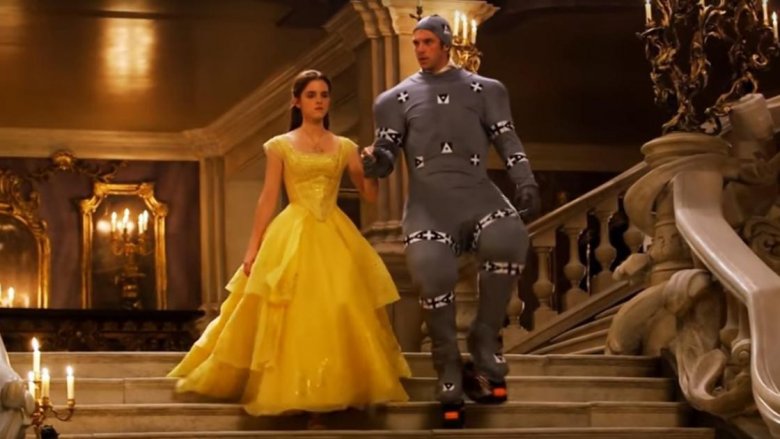
When Disney first announced their intention to remake a number of their beloved animated classics in live action format, the title that raised the most questions was Beauty and the Beast. Their rebooted version of The Jungle Book required them to render photo-realistic animals, though at least the protagonist was human. A film in which one of the two leads is a big hairy creature and the majority of the supporting characters are animated household objects was always going to rely on CGI, though director Bill Condon has never liked digital effects and actively avoided using them wherever possible.
"It was important to make everything that could be real, real," he told IndieWire. "I'm not a big fan of CG movies. The idea is to feel grounded in a world and not be distracted by things that felt like additions." Unfortunately for the man portraying the titular Beast, it was motion capture all the way. Dan Stevens (Downton Abbey) spoke to both Andy Serkis and Mark Ruffalo about their experiences in motion capture roles, and their feedback left him sweating. "I think I was mildly terrified," he said. "But that's really, generally what drives a lot of my decisions these days, is calibrating the right amount of terror."
The Dark Knight (2008)
Christopher Nolan's The Dark Knight was the first film to shoot scenes with IMAX cameras as opposed to using 35mm and converting in post. The director has "a very astute eye," according to the film's visual effects supervisor Nick Davis, who spoke to StudioDaily about his experience on the Batman flick. "It was important for the visual effects to look as though they were shot on set," he said. "[Nolan] didn't want the film to take on a gimmicky visual-effects look." Taking this route meant that Nolan's first sequel to 2005's Batman Begins was "a difficult movie to finish" as the visual effects had to be rendered in a higher resolution than ever before.
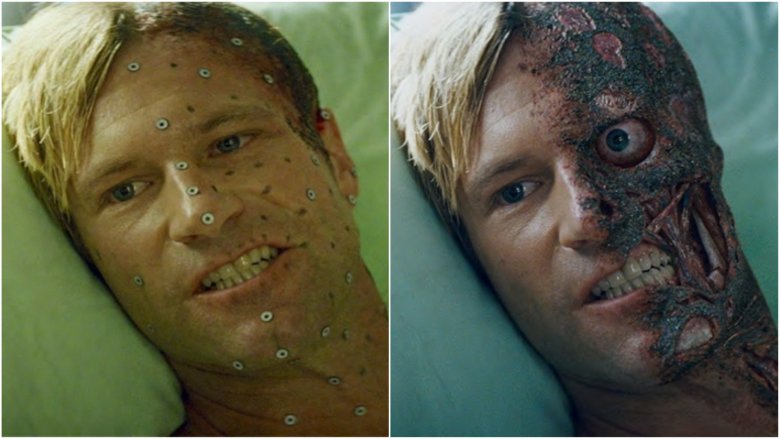
The Joker's look wasn't an issue as subtle prosthetic makeup sufficed, but when it came to the film's secondary villain, Harvey "Two-Face" Dent (Aaron Eckhart), Nolan wanted to remove layers, not add them. "This character was one of our major VFX challenges," Davis told AWN. "We actually removed the skin digitally. It allowed us to reveal the tendons, the cheeks, the eyeballs and to create unique textures." Two-Face's exposed eyeball had to be painstakingly animated by hand, as were the subtle changes in muscle tension.
The first-look of David Harbour's Hellboy is here. If you were wondering how the Stranger Things star would look as the devilish hero, then you don't have to wait any more. A picture of the actor in costume as the character as debuted, and it looks stunning.
Of course, fans are already starting to compare Harbour's Hellboy to the one that Ron Perlman made famous years ago. It looks like the reboot's take on the hero has a very different hair style than Perlman. The new version also has more defined eyes thanks to the lessened ridges on his brow.
A brand new promo just dropped for the Season 4 premiere of CW's The Flash, featuring the return of Barry Allen from the Speed Force.
But things aren’t what they seem in this teaser, as Allen might be a changed man after his time away. And he’ll also have to face another threat against Iris West and Central City. Check out the clip above.
The clip features Barry with a sweet beard and longer hair, as if he’s spent a lot of time in the Speed Force before finally returning to his friends and fiancé. Cisco even mentions that he’s made Barry a new suit, which we previously caught a glimpse of from set photos.
He appears to be feeling some lingering affects from his time away, with the footage hinting that he’s not quite the same happy-go-lucky Barry Allen that he’s been in previous episodes.
Game of Thrones season 7 will be hitting our screens on 16 July. To be fair, that's only 48 days away which could be seen by a lot of people as a short period of time. But in binge-watching hours, it's forever. You could watch hundreds of series in that amount of time if you put your mind to it.
When The Fast & The Furious hit the movie theaters in 2001, it was a breakout hit amongst the masses, despite the terrible ratings it received from reviewers. After having watched the movie for a good dozen times, I wholeheartedly agree with what the critics had to say: It's one of the most terrible movies that you can have a ton of fun watching.
However, we never realized when we watched the very first Fast & Furious movie, more than sixteen years ago, that the team of underground street racers was destined to rapidly morph into a team of world saving superheroes. Each and every iteration of the Fast & Furious movies had me repeatedly going back to watch the very first one. Because I needed something to cleanse myself of the action flick train wreck that I just witnessed, and to give myself false hopes that the next one will be more about cars and less about reclaiming nukes.
To prove how the very first Fast & Furious was truly special, I stumbled upon a behind the scenes film: The making of The Fast & The Furious. The movie was initially called "Redline", and everything surrounding it, the actors, the production, and the special effects, just oozed of street racing. If you can withstand the blurry-vision and the dated nature of the presentation, you'll find that this walk down memory lane is a pretty damn good one.
If you want to be shaken to the core, skip the horror movies and watch one of these docs.
Horror movies prey on our irrational fears to spook us. When they end, we might feel uncomfortable for a while, but we usually convince ourselves that there's nothing to fear.
It’s time to rejoice as the wait is finally over. It’s been more than a year since Game of Thrones season 6 finale got over and fans have been waiting for an excruciatingly long period of time for the new season. HBO has finally released Game of Thrones season 7 trailer and it is simply spectacular! Till now, we got to see few teaser trailers and HBO also released photos from season 7.
Since the start of the week, HBO has been treating the fans with content from the upcoming season. First, it included latest photos from the upcoming season, which included Daenerys sitting on a humongous Drogon and then a motion poster for Game of Thrones season 7 and today, after waiting for a long time, we have finally got the trailer for season 7. We now have to wait another 53 days before we get to watch Game of Thrones season 7, but we are glad that we at least got to see the trailer and it makes things easier and now my watch begins. Enjoy the trailer:
Netflix is about the release a TV series based on infamous drug lord 'El Chapo'. And it promises to be a cracker.
El Chapo, or 'The Shorty' as it translates (real name Joaquin Archivaldo Guzman Loera), will be the centre of a three-cycle TV thriller - given the same name.
It's the first collaboration between Univision and Netflix and the show will begin on the former on April 23, before moving to the latter after the episodes have had their first run.
The drama will show different parts of his life - the early years in the Guadalajara cartel, his rise to power, and his inevitable downfall.
The upcoming sequel to Disney's fan-favorite animated hit Wreck-It Ralph is one step closer to reaching screens.
The film has officially received a title and a release date, thanks to Disney's presentation tonight at CinemaCon.
The 2018 sequel will be called Ralph Breaks The Internet: Wreck-It Ralph 2, possibly hinting that the lovable cast of arcade game characters will literally enter the world of the Internet and online gaming. This was previously hinted at last summer, when the film's directors hinted that the film will possibly have a nod to TRON.
Few details are known beyond that, other than that original cast members John C. Reilly,Sarah Silverman, Jane Lynch, and Jack McBrayer will reprise their roles, and that Ugly Betty's Ana Ortiz will be joining the cast in an unknown role.
The official description of the news from Disney's CinemaCon panel is as follows:
"A sequel to Wreck It Ralph is coming in 2018 with Rich Moore, Phil Johnston directing and Clark Spencer directing. John C. Riley and Sarah Silverman are returning. March of 2018. Jane Lynch joins as Sargeant Calhoun and Jack McBrayer returns."
Are you excited for the sequel? Sound off in the comments below.
Three years ago, in the pages of Original Sin, Nick Fury whispered something into Thor’s ear that made the Odinson unworthy, and incapable of wielding his hammer, Mjolnir.
In The Unworthy Thor #5, which released in comic shops today, the words Nick Fury said were finally revealed.
"Gorr was right."
Three simple words that undid the God of Thunder. Those words go all the way back to Thor: God of Thunder, where Gorr the God Butcher, who committed countless acts of deicide, declares all gods were unworthy.
But that wasn't the only major reveal in Unworthy Thor #5. ComicBook.com spoke to writer Jason Aaron about the momentous issue.
You’ve stated before that the words that made Thor unworthy were in your notebook from the beginning. If the words have remained the same, how has the journey towards revealing them changed since then?
Jason Aaron: I don't think it has changed other than just kind of figuring out the timing of everything. I think that when we made that change, made Thor become unworthy and brought in Jane Foster, we had no idea what the reaction would be, so if sales had tanked and everybody had hated it that kind of would have determined how long that story lasted. But thankfully the response to that was great.
The 2017 Kids' Choice Awards are going on now and thanks to the annual show hosted by Nickelodeon, we're getting our first look at a brand new Cars 3 trailer — and a fan-favorite character makes his first appearance.
In the trailer, we see the trilogies' main character Lightning McQueen (Owen Wilson) can be seen going to Mater (Larry the Cable Guy) for some advice and in classic Mater fashion, little to no useful advice is shared between the two.
Wilson and Larry the Cable Guy reprises their roles among a star-studded cast consisting of the likes of Cheech Marin, Bonnie Hunt, and Armie Hammer in addition to new additions to the franchise like Nathan Fillion (Firefly) and Kerry Washington (Scandal).
Cars 3 is set to release in theaters June 16, so expect to hear a lot more about the story and characters in the coming months as Disney and Pixar gear up for its release.
Are you excited for the return of the classic franchise? Let us know with your vote in the Anticipation Rankings!
Cars 3 will be speeding into theaters on June 16, 2017.
Blindsided by a new generation of blazing-fast racers, the legendary Lightning McQueen is suddenly pushed out of the sport he loves. To get back in the game, he will need the help of an eager young race technician with her own plan to win, inspiration from the late Fabulous Hudson Hornet, and a few unexpected turns. Proving that #95 isn't through yet will test the heart of a champion on Piston Cup Racing's biggest stage!
.png)